This chapter establishes foundational knowledge about the infrastructure required to launch a self-hosted WordPress website. Students will learn to distinguish between domain registrars and hosting providers, evaluate hosting options, and purchase a domain and set up hosting. The chapter uses real-world analogies and provider comparisons to demystify concepts that are often confusing for those new to web development, preparing students for WordPress installation in Chapter 2.
Learning objectives
After completing this chapter, learnings will be able to:
- Explain what a domain name is and how it differs from web hosting
- Describe how domain registrars and hosting providers work together
- Identify key criteria for evaluating hosting providers (uptime, support, server specifications)
- Complete a domain purchase and hosting setup independently
What is a domain?
The domain name is the address of your website. When we talk about owning one’s domain, we are talking about owning (technically renting) an address on the Internet. You may also hear the term URL – Uniform Resource Locator – that is the technical term for the website address.
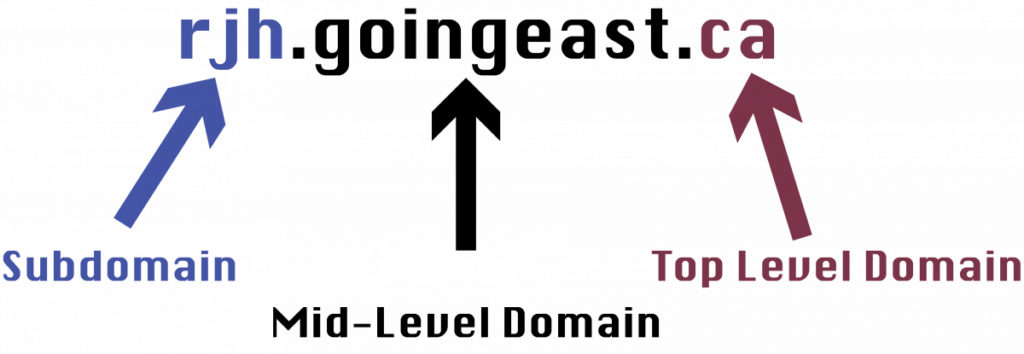
Top level domain. Historically, there were only a few that were 2 or 3 letters and each had a specific meaning. The most common one is .com which stands for company. You will also be familiar with .edu which represents educational institutions. There are also country specific top-level domains such as .ca for Canada. Now there are many more, some of which are gaining popularity but the most common is by far .com.
Mid-level domain. The main part of a domain name. It is the part that most people remember. When you purchase a domain, you are purchasing a mid-level-domain and top level domain combination (e.g. goingeast.ca).
Subdomain. When you own your own domain you can create as many subdomains as you like.
Domain registrars
When you decide to launch a website, you need someone to help you claim your domain name in the global domain registration system. That’s where domain registrars come in. A domain registrar is an accredited business that acts as an intermediary between you and the organizations that actually manage and maintain the internet’s domain system.
When you register a domain through an accredited registrar, you enter into a legal agreement with that registrar. This agreement specifies the terms under which you can use the domain, including renewal procedures, payment terms, and your rights regarding the domain registration.
The registrar collects your contact information—your name, address, email, and phone number—and submits this to the domain registry, where it is stored in the global WHOIS database. This information is crucial because it establishes you as the official registrant, or owner, of the domain.
One important clarification: while people often say they “own” a domain, technically you are leasing the domain for a specified period, typically between one and ten years. Domain registries own all domains; registrars and registrants are granted the right to use them for a limited time. This distinction is important for your understanding of how domain management works.
It’s also worth noting that not all domain sellers are registrars. Some companies act as resellers, which means they partner with accredited registrars but are not themselves ICANN-accredited. Resellers purchase domains from registrars and resell them to customers, often bundling them with additional services like web hosting or email.
While many resellers are legitimate and offer valuable bundled services, they may not always provide the same level of support or direct access to registry information as an accredited registrar would.
Note: When you buy your domain name from your hosting provider, you make it more difficult to change hosting provider.
Domain name renewal cycles and costs
Understanding domain costs requires distinguishing between initial registration prices and renewal fees—a distinction that often surprises new domain purchasers. When you first register a domain, registrars frequently offer promotional pricing, sometimes dramatically discounted from the standard rate. However, once that initial period ends, your renewal cost will typically be much higher.
Initial Registration Costs: For standard, non-premium .com domains, expect to pay between $10 to $20 per year for the initial registration. However, registrars often use promotional pricing to attract new customers, so you might see first-year registrations advertised for as little as $0.99 to $2.99. Other common top-level domains follow similar patterns: .org domains typically cost $10 to $18 per year, while .net domains run $12 to $20 per year. Newer or less common TLDs, such as .online, .site, or .xyz, are often priced lower, sometimes under $5 for initial registration. Conversely, specialized TLDs designed for specific industries or geographic regions—such as .cars, .inc, or .rich—can carry premium pricing of $1,000 or more.
The Renewal Price Shock: This is where domain costs become important to understand. Renewal prices for .com domains typically range from $15 to $25 per year, and in some cases can be two to three times higher than the initial registration price. For example, a domain registered for $2.99 in year one might renew at $21.99 annually. Over a five-year period, this difference adds up significantly. A domain that cost $2.99 initially would total $90.95 over five years ($2.99 + [$21.99 × 4]), whereas a registrar with consistent pricing of $13.99 per year would cost only $69.95 total—a savings of over $20.
What is website hosting?
What do we mean by web hosting? Everything on the web needs to exist on a computer, called a server, somewhere. The folks that provide the service of hosting websites on their servers are called website hosts. When you purchase website hosting, you are renting space on a server that is accessible on the Internet.
What is DNS?
DNS (Domain Name System) is the internet’s address book: it translates your easy-to-remember domain name (e.g., yoursite.ca) into the numeric IP address of the server where your self‑hosted WordPress site lives, so visitors reach the right place. In practice, after you buy your domain and hosting, you either point the domain to your host by updating the nameservers at your registrar (to the ones your host provides) or by creating DNS records. Once saved, changes can take some time to propagate worldwide (often minutes, but up to 24–48 hours), after which typing your domain in a browser will load your WordPress site.
Tip: For all in one domain name and hosting service, with excellent customer service I recommend Reclaim Hosting. They are specifically setup to support students who are learning how to create their own self-hosted domain. They are familiar with WordPress and if you get into trouble they are usually very quick to help you sort things out.
Note: If you purchase your domain name from one place and your hosting service from another, you will need to tell your domain name provider what the address is of the server your website is hosted on.